
It was the day before my 50th birthday and I peered through a cyclone fence covered in ivy. Behind the fence was a dilapidated yet still very grand chalet. We were in Austria, where I was on a quest to seek out locations for a mythical place
Read more: Chalet School Pilgramage‘Why are we here again? What’s this place got to do with your school?’ asked my 12-year-old.
‘Not my school. The school I wanted to go too. The Chalet School.’
She shrugged. ‘Can we rent Segways? Much more fun.’
How do I explain the appeal to my family who I’ve taken to this beautiful lakeside village which is allegedly the setting for a fictional boarding school? And why does it mean so much to me?
Go back to the child in outer suburban Australia in the 1970s. I was an only child and a bookworm. I preferred books to people, though longed to be part of a gang, a clique, a community. But I didn’t know how. The teammate Australian subcultures of the era; the surfers, the skinheads and the popular girls— I did not fit in to any of it. But one day, in the school library, I picked up a book, The School at the Chalet by Elinor M Brent-Dyer. The cover sucked me in and then I became engrossed in the story of an English woman who starts a school in the Austrian Alps on the shore of Lake Tiernsee. She is virtually penniless, but somehow, she rents a chalet, acquires local pupils and the adventures began. Two generations of schoolgirls getting lost in snowstorms, eating delicious food, learning three languages, and having ski lessons. All this at a wonderful school, with lovely friends, understanding staff and a location far removed from my orange brick high school in suburban Melbourne.
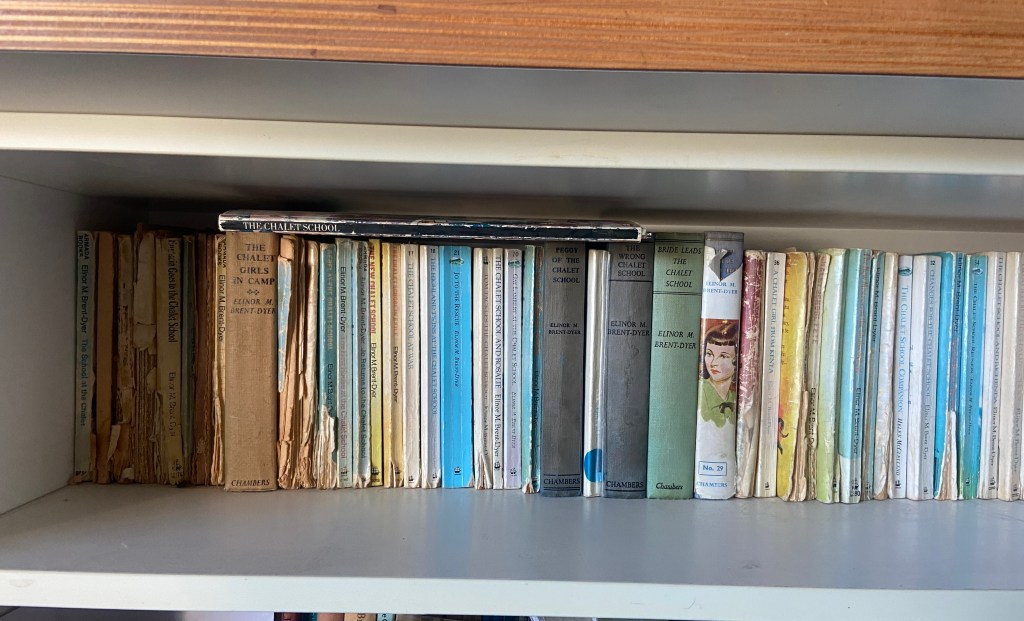
I set out to borrow, beg or buy more books in the series. Living in Australia, the books were hard to get. I read them out of order, confused at the change of locations from Austria to the Channel Islands, South Wales and finally, back to the Alps – Switzerland. A cast of characters had jolly japes with swimming galas, Christmas pageants, and battles between the prefects and naughty middles. Ever present was the spirit of the school, Joey Bettany (sister of the woman who started the school) a wild tomboy who turned into a beloved Head girl, an author and mother of 14 children. Secondary characters- such as a best friend, popped up at intervals and then were never seen again. The author drew on stories, traditions and life in the different regions. Through these books, I picked up basic phrases in French and German, fragments of Swiss History and a knowledge of the Passion Play all without leaving my house. I longed to be at such a school and wondered if I could wangle it. I read and reread until I could parrot off German phrases, understand German menus and was familiar with the main attractions of Innsbruck and the Austrian Tyrol.
As years passed, the books sat on my shelf and I never picked them up. But I couldn’t throw them out – too big a part of my life for that.
Due to the wonders of the internet, I found Chalet School fan groups. I was thrilled to find out that although the Chalet School did not exist, the Austrian locations had been pinpointed by fan-detectives as Lake Achensee district. The author had spent a couple of holidays there, and based on her love for the area decided to set it as the location for her books. Achensee was the Tiernsee. Jenbach was Spartz. There were a few name changes, but essentially the same place.
Back to our trip.We arrived in Pertisau the same way as the Chalet school girls did. A train to Innsbruck, connect to Jenbach and then a short drive up into the heart of the mountains. We whizzed past tiny villages with frescoed chalets, fields so green they dazzled and finally arrived at the shores of the deep blue lake.
Our hotel was an Austrian dream- the staff wearing leather lederhosen and dirndl skirts. Outside, near the parked Segways, were two llamas, named Barack and Michelle(Olama). Our daughters patted their soft noses.
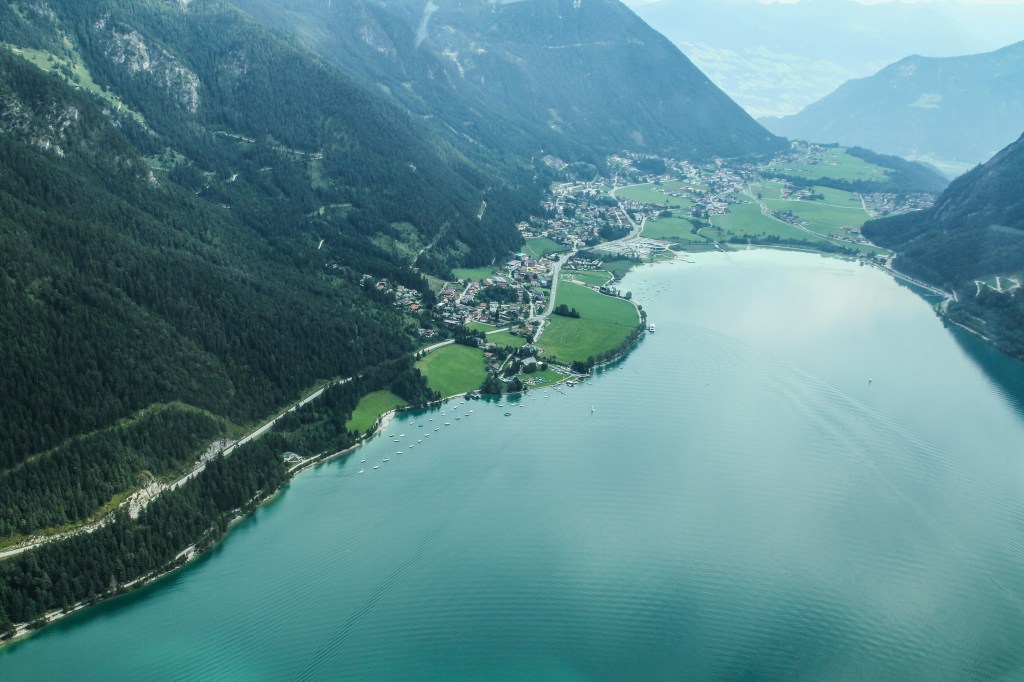
We walked around a town, now a modern place full of glorious chalets and window boxes full of flowers and hikers in sensible hiking boots who greeted us with the Austrian salute, Gruss Gott. The village was beautiful but lacking something, perhaps a school?
One day we headed for Geislam and the Dripping Rock – the site of many a Chalet school adventure, usually involving a near-death by drowning, the victim rescued and dosed with schnapps to stop her getting a cold. There were no near drownings on our walk, but my husband and children had a quick dip in the lake and came out with chattering teeth and demanded hot chocolate and whisky.
‘Coldest water ever,’ my daughter said. ‘Makes you feel good though.’
We took a cable car up to the Barenbad Alpe and ate our sandwiches. Following on from one of the scenes in the books, we picked wildflowers, sang songs from The Sound of Music and I tried out my bad German on passing hikers.
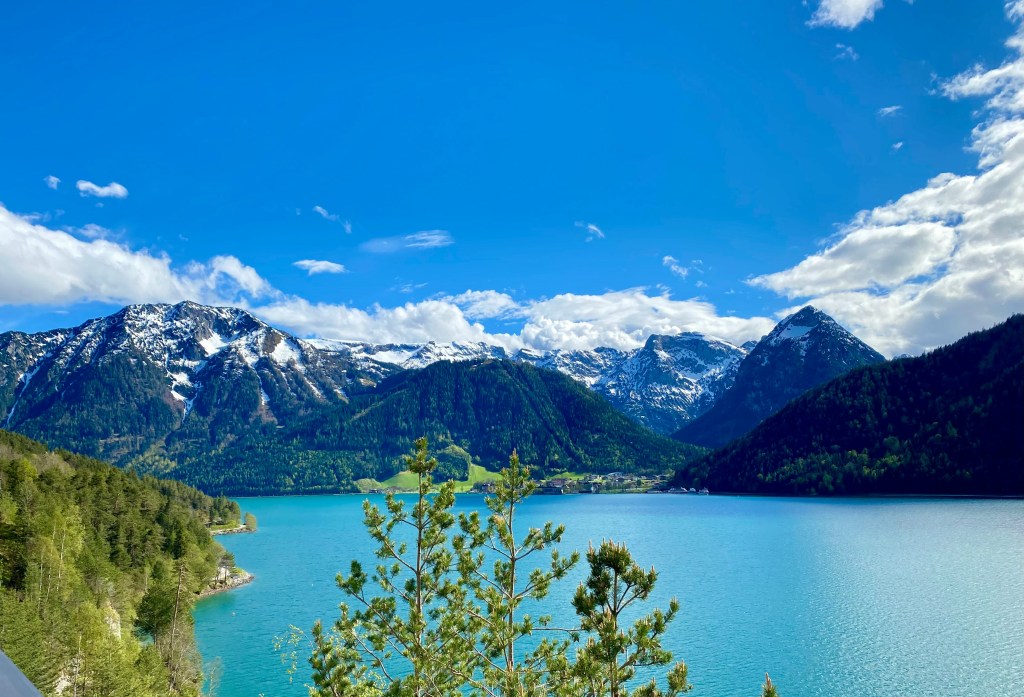
On my actual birthday, the hotel receptionist gave me a voucher for a shale oil bath (shale oil is produced in the area). Late that afternoon, after a long walk and a large afternoon tea with heavenly cakes and mountains of whipped cream, I luxuriated in the black shale oil bath water. My skin had never been so soft, though the after smell was not unlike engine oil. But a small price to pay when I could lie in the tub, look out on the mountains and thank the Chalet School for leading me to this strangest of experiences.
It came to our last day and we were having our usual stilted conversation with our charming breakfast waiter. Clearing the table, he asked, ‘Are you coming to see the cows today?’
We were puzzled. Cows had not been mentioned as a tourist attraction in Pertisau. Pertisau is a place where you go to walk up mountains, eat huge amounts of food, brave the icy waters of Lake Achensee and do the same again.
On questioning, we learned that each September, the cows that graze up on the high alms are walked down to the valley in order to be housed for the long European winter. The festival is known as Almbetreib and is an annual festival across Austria. We were intrigued. Cattle in our country are worshipped at the BBQ! As my husband is of Indian origin, he could appreciate a little of this cow idolatry. Additionally, I recalled that this custom was mentioned in the early Chalet School books.
We wanted to learn more and considered it a fitting end to our Austrian holiday. Our children were harder to convince. ‘What’s the big deal about a bunch of cows walking down from the hills?’ asked Miss Twelve. Miss Fourteen plugs herself into her iPod and looks bored as we explained the concept as best as we can.
At midday, we joined throngs of locals walking through the town and past the pastures to the head of the valley. We passed people setting up deckchairs in the blazing noonday sun, awaiting the appearance of the cows. We ate our lunch sitting on tree stumps in the forest. our children were still plugged in to their devices. We talked to an elderly British couple who told us the biggest milk producers of the cows will wear a special yellow garland, and the lead cow of the procession, a red garland and wreath.
Suddenly, a cry goes up, which translated to ‘They are coming.’ Our children abandoned their iPods and ran off into the distance so they could see the first of the cows. Lines of cows accompanied by schnapps-sipping, lederhosen-clad, gorgeous blonde giants. As the cows passed into the centre of Pertisau more and more people joined them, so it became a joint procession. Sounds of cowbells jangling and cows mooing drown out our conversation. Temporary bars had been set up with the landlords offering the cow’s guardian’s liberal swigs of schnapps and enormous steins of beer. Our children played spot the best garland and wrinkled their noses at the fresh cow droppings.
As we reached the centre of town, there was a brief respite as the cows, their guardians and the townsfolk gathered at the meadow. There were speeches, there was a schnapps bar and dancing and it was only 1.30pm on a Friday afternoon. Sadly, we had to leave as we had been advised by the hotel that our car transfer to the local station would have to leave earlier due to the cattle. ‘If you leave later, you may get stuck behind the cows and they won’t care that you have to catch a plane.’
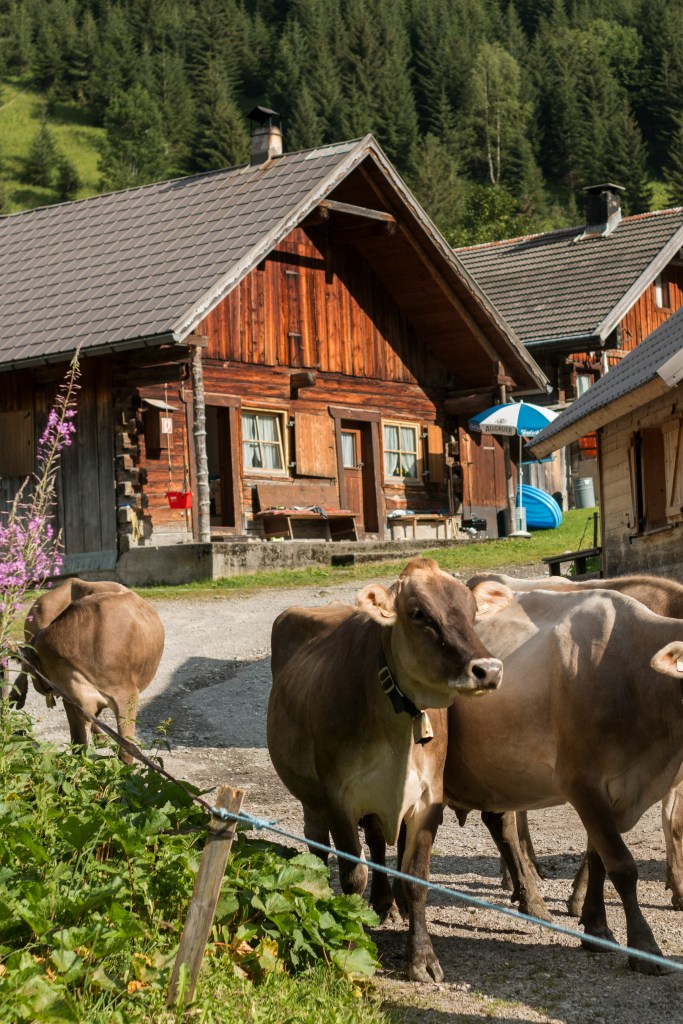
It could have been a very Chalet School adventure. Missing a plane because we got caught up in a traffic jam caused by a group of slow-walking cows. Elinor M Brent- Dyer would have liked that.



 The Pelvic Floor Coffee Club